
Neither Offshore Nor Nearshore: A Better Way to Build Software in Japan
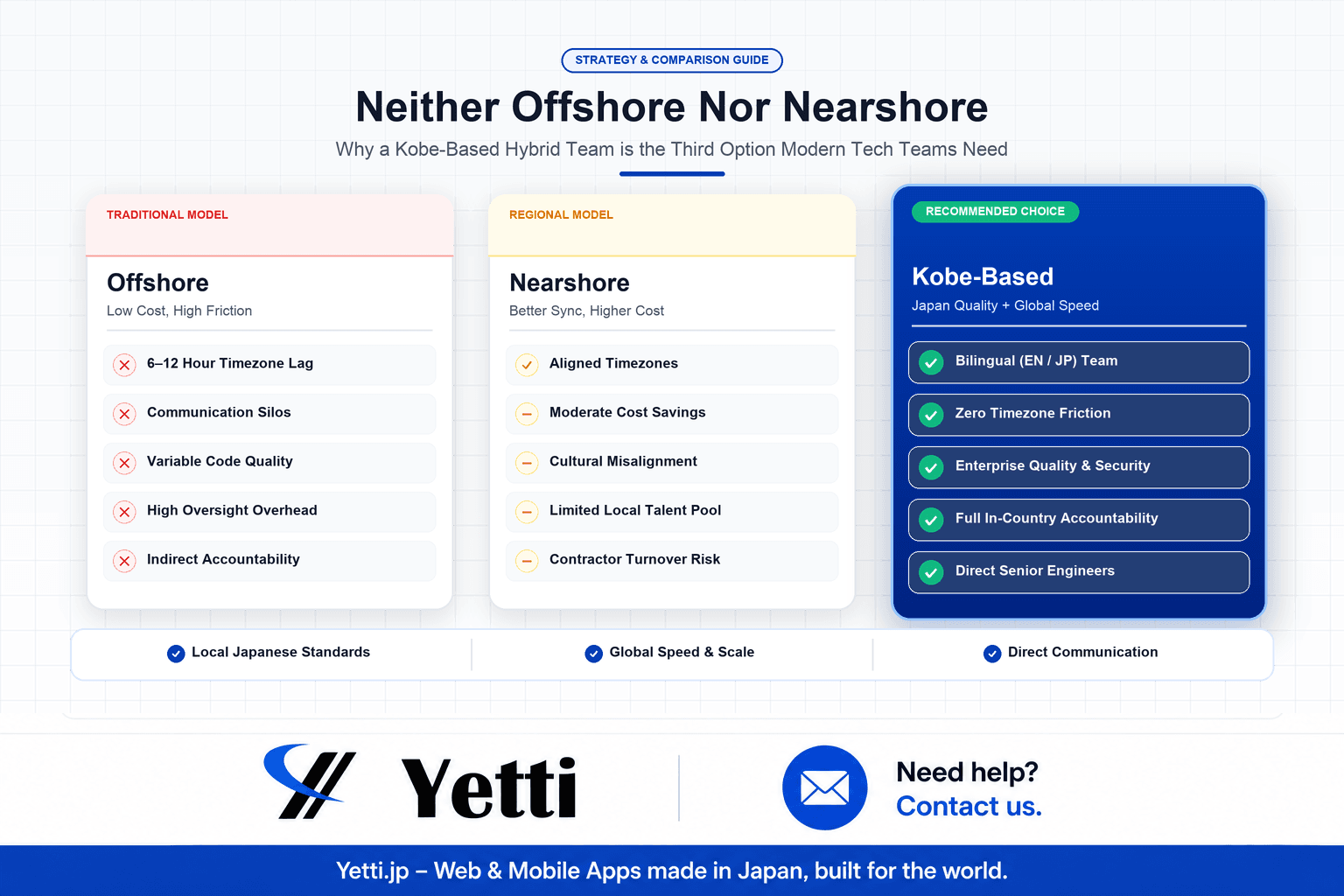
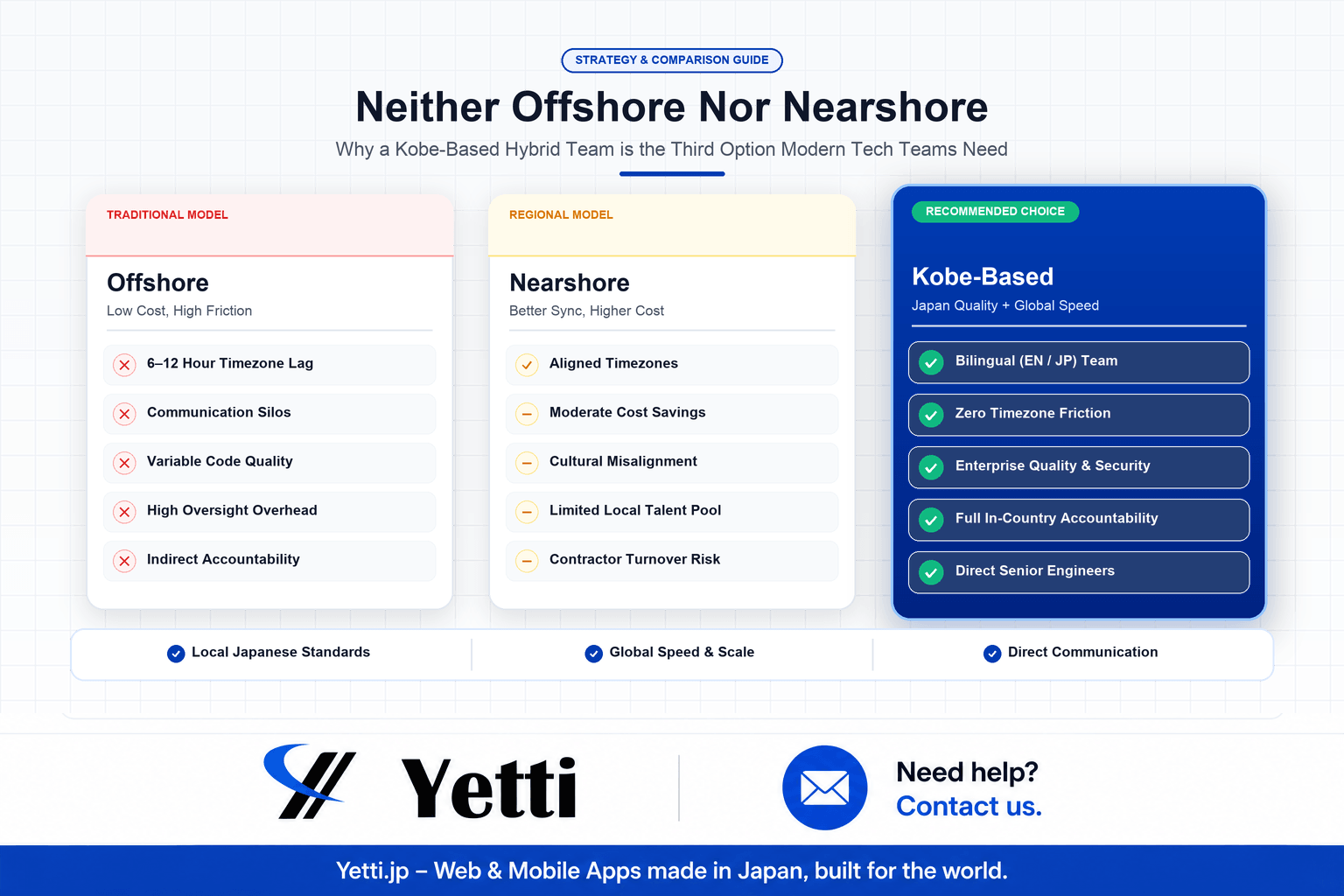
When foreign companies operating in Japan look for a development partner, they usually face the same two labels: offshore (オフショア) — sending work overseas to cut cost — or nearshore (ニアショア) — keeping it domestic to protect quality and communication.
Both come with a ceiling. Offshore looks cheaper on paper, but time zone lag, language barriers, and cultural distance turn into misread requirements and expensive rework. Nearshore keeps communication smooth, but Japan's IT talent shortage pushes rates up — the cost advantage over Tokyo keeps shrinking.
Most companies actually need all four things at once: high quality, smooth communication, real speed, and a fair price. The offshore/nearshore binary was never built to deliver all four together.
Where Each Model Hits Its Ceiling
Offshore means contracting engineering work overseas. The sticker price is attractive because labor costs in destination countries are lower. But the hidden costs surface later — misaligned specs, delayed clarifications, and rework cycles that erase the initial savings.
Nearshore (in Japan, meaning regional domestic hubs outside Tokyo) solves the communication problem. Shared language and business norms keep quality steady. But the pricing gap is closing fast, because Japan's IT labor shortage isn't a Tokyo-only problem — it's nationwide.
A Third Option: Global Talent, Kobe-Based
The usual version of offshore moves the work to where the engineers are. The third option does the opposite — the engineers come to Japan, working in the same location, on the same time zone, with a Japanese-led client interface.
Here's what that looks like in practice:
Same City, Zero Time Difference
Engineers work from Kobe, not from overseas. There is no lag on a decision, no message lost in translation, and no 14-hour wait for a clarifying answer.Japanese-Led Client Relationship
Requirements definition, project management, and client communication run through Japanese staff. Nothing depends on the client being comfortable working in a second language.Global Engineering Depth
The technical team spans engineers trained at premier international institutes — including graduates from the Indian Institute of Technology (IIT), the University of Delhi, and the Indian Institute of Information Technology, Design and Manufacturing (IIITDM) — bringing a breadth of expertise that a single domestic hiring pool or a single offshore vendor cannot match.Built-In Quality Control
When engineers and project leads share the same room and the same working hours, misunderstandings get caught before they become delivered bugs.
How the Three Models Compare
| Comparison Feature | Offshore | Nearshore | Kobe-Based |
|---|---|---|---|
| Development cost | Lowest | Limited savings | Competitive |
| Quality consistency | Variable | Strong | Strong, Japanese standard |
| Communication | Time zone / language barrier | Smooth | Japanese, in person |
| Time difference | Present | Minimal | None |
| Technical depth | Depends on vendor | Depends on region | Engineers from top institutes |
| Handling spec changes | Often slow | Responsive | Fast |
Build Without the Tradeoff
At Yetti, we built our team around a simple idea: the thing that erodes quality on a distributed project is distance — in time zone, language, and physical location — and the simplest way to fix it is to remove all three.
Our engineers work from Kobe, side by side, on Japan time. Our Japanese staff lead every client engagement. And the result is a development pipeline where quality and cost stop trading off against each other.
If your company is operating in Japan and looking for a development partner that delivers both quality and value, we are ready to talk.
Yetti.jp – Web & Mobile Apps made in Japan, built for the world.
Ready to build your next product?
Let's discuss how we can help bring your vision to life.